Rules
Part of Circular fashion design: a practical guide (2027 update)
When is extra scrutiny worth it for fashion design?
Circular fashion design problems diagnosed: find why products fail, repairs stall, returns lose value, recyclers reject feedstock, and claims exceed evidence.
What to take away
- Diagnose the failed outcome before redesigning the product.
- Product, service, customer, logistics, sorting, and processing failures can look alike.
- Collection volume is not proof of reuse or recycling.
- A repair failure may come from access, parts, skill, cost, information, or lost performance.
- Stop broad claims when route data, material identity, or partner capacity cannot be confirmed.
Circular design failures often appear after launch. A take-back program collects more damaged goods than expected. A replaceable part is never replaced. A recycler rejects a product described as mono-material. A durable garment remains unworn because of fit or comfort.
Do not solve every problem by adding material or another service. Preserve records, define the symptom, locate the stage where value is lost, and test a focused correction. The intended value flow is described in the circular design reference.
Symptom map
| Symptom | Plausible causes | First evidence | Do not assume |
|---|---|---|---|
| Early holes or seam failure | Wrong test, weak construction, use mismatch, care damage | Failure location and retained sample | Heavier fabric is the only fix |
| Product is sound but unused | Fit, comfort, style, care burden, changed need | User and return reason data | Physical durability guarantees use |
| Repair is declined | Cost, access, delay, parts, trust, unclear service | Repair quotes and customer path | Users do not care about repair |
| Repair damages another area | Inaccessible assembly, weak aged material, wrong method | Repair trial and construction map | More instructions solve access |
| Take-back return rate is low | Poor access, weak incentive, unclear terms, low trust | Market coverage and user journey | Product design alone caused it |
| Returned items cannot be resold | Condition, odor, stains, missing information, no demand | Grading and sell-through records | Collection equals reuse |
| Recycler rejects product | Blend, elastane, coating, trims, chemistry, format, volume | Current input specification | Mono-material wording proves fit |
| Processing yield is low | Contamination, moisture, sorting error, material loss | Mass balance by process stage | Shipment mass became new fiber |
| Circular claim is challenged | Scope too broad, route unavailable, outdated partner record | Claim-to-evidence file | Good intent is enough |
Diagnostic order
1. Verify the product and revision
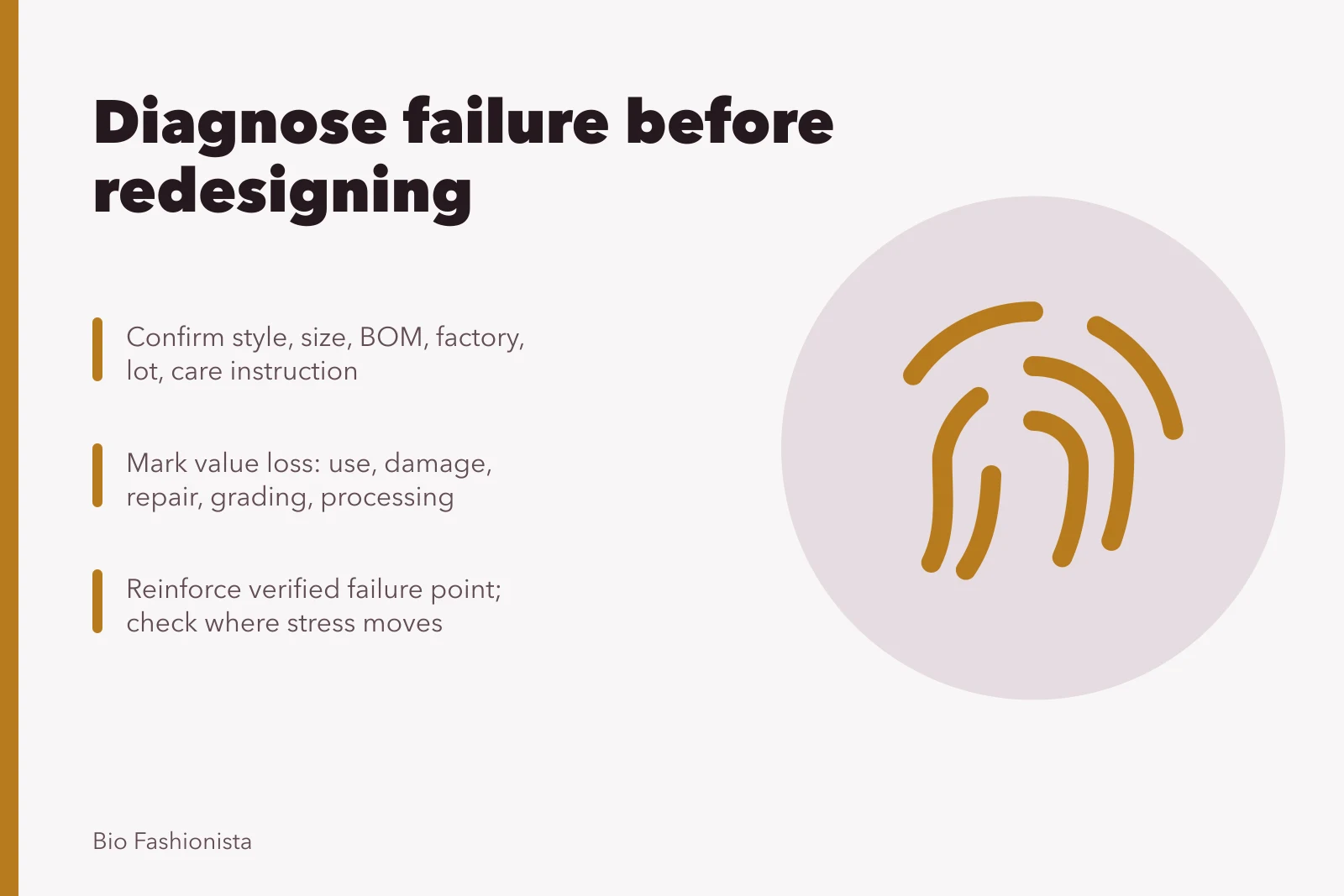
Confirm style, size, color, bill of materials, factory, recipe, lot, care instruction, and service market. A design may change after a prototype was approved. The downstream record may describe a different material.
2. Locate the value loss
Mark the exact transition:
Locate the value loss
- sale to first use
- use to damage
- damage to repair decision
- first user to next user
- return to collection
- collection to grading
- grading to processing
- feedstock to recovered output
Measure the numerator and denominator. "Most returned items were repaired" means little without the number sold, offered the service, returned, accepted, repaired, and put back into use.
3. Separate technical and operating causes
A zipper can be physically replaceable while the brand stocks no replacement. A recycler can technically process a fiber but decline small, mixed, or distant loads. A reusable product may lack demand in its returned size and condition.
The EEA's current indicator on repairability of textile products reports Repair Cafe outcomes while explicitly noting limits in representativeness, volunteer assessment, and defect categories. Follow that caution: service data describe the observed channel and should not be presented as a universal product rate.
4. Reproduce the failure
Use a production-equivalent sample and realistic conditions. For repair, record access, tools, parts, time, damage, and restored function. For disassembly, record component yield and contamination. For resale, grade blind against a defined standard. For recycling, run the processor's specified trial and document output.
5. Test the correction
Change one controlled variable when possible. A reinforcement may move failure to the edge of the patch. A removable fastener may loosen in use. A simplified blend may reduce stretch and shorten use. Repeat affected safety, function, care, and route checks.
Cause and correction table
| Confirmed cause | Focused correction | Release evidence |
|---|---|---|
| Stress concentrated at pocket corner | Change shape, reinforcement, stitch, or allowance | Wear and seam tests on full assembly |
| Replacement part unavailable | Standardize part and set stocking period | Inventory, service test, customer access |
| Bond blocks zipper access | Redesign assembly or access sequence | Timed repair with no collateral damage |
| Resale label cannot be authenticated | Use durable identity and records | Grading and listing trial |
| Sorter cannot identify coating | Add verified material data | Sorter acceptance and data access |
| Recycler rejects elastane level | Change material or partner claim | Written input acceptance and process trial |
| Take-back copy exceeds geography | Narrow markets and conditions | Live customer journey in every named market |
Common false fixes
Add more reinforcement everywhere
This increases mass and may reduce comfort, repair access, or recyclability. Reinforce a verified failure point and check where stress moves. Reading the failure right comes first; the natural fiber failure diagnostics separate fiber, construction, and care causes.
False fixes to avoid
- Add more reinforcement everywhere
- Call every visible repair circular
- Switch to one fiber without processor input
- Build take-back before a destination
- Count material sent, not recovered
Call every visible repair circular
Repair can extend use, but a decorative patch does not prove restored strength, safety, water resistance, or customer acceptance. Test the required function.
Switch to one fiber without processor input
Composition simplification can help, but dyes, coatings, thread, labels, hardware, format, and volume may still block a route. The comparison of circular approaches shows why route fit is product-specific.
Build a take-back program before a destination
Collection creates custody and cost. Secure grading, reuse, recycling, and lawful residual routes before promising a loop.
Count material sent, not material recovered
Report feedstock received, rejected, prepared, processed, recovered, lost, and used in a new application. Avoid treating transfer to a contractor as the outcome. Overclaiming a loop is a classic case for the weak-claim diagnosis guide.
Repair-specific cautions
The European Commission's textile preparatory study discusses how design can affect apparel repairability, including access and disassembly for replacement of damaged parts. Use its findings as design context. A safety-critical or protective product still needs qualified repair procedures and retesting.
Stop ordinary repair when
- Suspected hazardous contamination
- Damaged protective function
- Electrical or heated components
- Severe mold
- Unknown chemical residue
- Legal requirement for authorized service
Prevention record
- Capture structured return and failure reasons.
- Keep retained production samples.
- Test the weakest component and full assembly.
- Perform repair and disassembly before release.
- Version every bill of materials and instruction.
- Reconfirm partner specifications and capacity.
- Track mass and item outcomes after collection.
- Audit claim text against current geography and evidence.
Common questions
Why is a high repair success rate not enough?
It may cover only items that users chose to bring, one channel, and repairs volunteers accepted. Record the population and limits.
Can durability make recycling less important?
Longer use can delay waste, but products eventually leave service. Plan a realistic next route without sacrificing present function.
What if the recycler changes its specification?
Reassess affected products and claims. Partner or technology change is a formal review trigger.
Is low take-back participation a design failure?
It can be, but access, communication, incentive, trust, geography, and customer behavior may be the main causes.
When should a claim be removed?
Remove or narrow it when product identity, service access, partner acceptance, current capacity, or measured outcome no longer supports the wording.