Maintenance
Part of Textile reuse and recycling: how to choose a route
Reuse and recycling checklist: confirm scope, condition, operator, acceptance, downstream route, measurements
Textile reuse and recycling checklist: confirm scope, condition, operator, acceptance, downstream route, measurements, evidence, claims, and unresolved material.
What to take away
- Apply the checklist to a named batch, program, period, and location.
- Treat collection, preparation for reuse, actual reuse, and recycling as separate events.
- Stop unsafe or prohibited material before it enters a general stream.
- Reconcile received mass with outputs, stored inventory, and residues.
- Publish only claims that the records support at the stated boundary.
Use this checklist before approving a take-back program, donation partnership, recycling shipment, procurement claim, or annual result. Mark each item Pass, Review, Fail, or Not applicable. Add the record, owner, and correction date.
A Pass means evidence was checked. It does not mean someone answered "yes" in a meeting. Route and outcome definitions come from the main reuse and recycling guide.
1. Scope and ownership
- The products, brands, sites, countries, channels, and dates are defined.
- Post-industrial scrap, returned goods, unsold stock, and post-consumer items are separated.
- The measurement unit is stated and used consistently.
- A named person owns acceptance, safety, claim, and correction decisions.
- Legal title and responsibility at each handoff are documented.
Stop if: the program cannot identify what material its result covers.
Scope and ownership checks
- Products, brands, sites, countries, channels, dates defined
- Post-industrial, returns, unsold, post-consumer separated
- Measurement unit stated and used consistently
- Named person owns acceptance, safety, claim decisions
- Legal title and responsibility at each handoff
2. Waste context and baseline
- The baseline uses a stated year and comparable boundary.
- Generation, collection, reuse, recycling, combustion, landfill, and unknown routes are not combined.
- Inventory changes are included.
- Public statistics are dated and labeled by geography and material scope.
EPA's 2018 facts and figures fact sheet separates generation, recycling, combustion with energy recovery, and landfilling for textiles in US municipal solid waste, reporting a 14.7 percent recycling rate on 17 million tons generated. Use those figures only for their stated system and 2018 reference year, not as a current rate for one brand or city.
EPA 2018 textile waste figures
- 17 million tonstextiles generated in US MSW
- 14.7 percenttextile recycling rate
- 2018reference year for the figures
3. Condition and safety
- Wearable condition has an operational definition.
- Repairable defects and rejection limits are written.
- Wet, moldy, pest-affected, sharp, or chemically contaminated material is isolated.
- Recalls and product-specific restrictions were checked.
- Workers have suitable handling procedures and protective equipment.
- Medical, protective, or privacy-sensitive products receive specialist review.
Stop if: general staff cannot safely handle the material or its required treatment is unknown.
Condition and safety checks
- Wearable condition has an operational definition
- Repairable defects and rejection limits written
- Wet, moldy, pest-affected, sharp, contaminated material isolated
- Recalls and product-specific restrictions checked
- Workers have handling procedures and protective equipment
- Medical, protective, privacy-sensitive products get specialist review
4. Collection controls
- The operator's identity and contact information are verifiable.
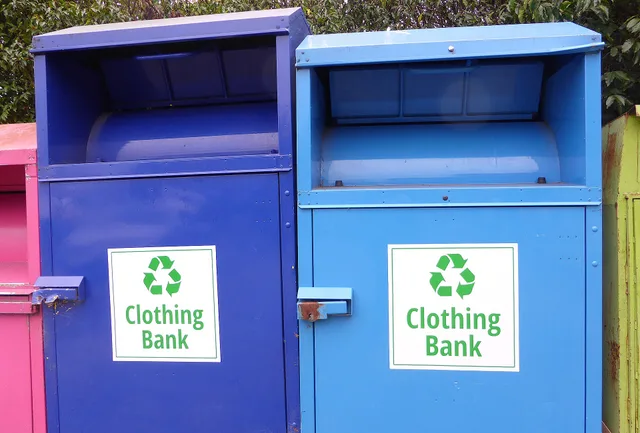
- Signs state accepted items, prohibited items, condition, and packaging.
- Containers protect material from weather, pests, fire, and unauthorized removal.
- Overflow, contamination, complaints, and emergency pickup have owners.
- Collection frequency matches volume and storage capacity.
- Each pickup has a date, location, quantity, carrier, and receipt.
Review if: a contractor, broker, or landlord controls the bin but the public-facing name implies otherwise. Operator verification is Step 6 of the used textile routing guide.
Collection control checks
- Operator identity and contact verifiable
- Signs state accepted, prohibited, condition, packaging
- Containers protect from weather, pests, fire, removal
- Overflow, contamination, complaints, emergency pickup owners
- Collection frequency matches volume and storage
- Each pickup has date, location, quantity, carrier, receipt
5. Sorting and grading
- Sort categories match actual downstream specifications.
- Reuse grades consider function, safety, demand, size, and season.
- Material grades record composition, construction, color, finish, and trims where relevant.
- Fiber-label uncertainty is recorded.
- Rejected and downgraded items remain measurable.
- Sampling plans state how items were selected and what they cannot establish.
Fail if: workers are told to classify all clean textiles as recyclable without a confirmed processor.
Sorting and grading checks
- Sort categories match downstream specifications
- Reuse grades consider function, safety, demand, size, season
- Material grades record composition, construction, color, finish
- Fiber-label uncertainty recorded
- Rejected and downgraded items remain measurable
- Sampling plans state selection and limits
6. Reuse route
- A buyer, user, or market exists for the product grade.
- Cleaning and repair responsibilities are set.
- Unsold inventory and return periods are tracked.
- Exported items have destination and receiving-route records.
- Transfer to an intermediary is not automatically counted as final reuse.
- Product safety and branding requirements are satisfied.
Evidence examples: sale record, documented distribution, rental event, redeployment record, or processor report using an explicit reuse definition.
Reuse route checks
- Buyer, user, or market exists for grade
- Cleaning and repair responsibilities set
- Unsold inventory and return periods tracked
- Exported items have destination and receiving records
- Intermediary transfer not counted as final reuse
- Product safety and branding requirements satisfied
7. Recycling route
- The processor supplied a current written feedstock specification.
- Capacity is available for the volume and timing.
- Pretreatment, hardware removal, and packaging are defined.
- Process input, yield, recovered output, and residues are measured.
- Textile-to-textile and non-textile outputs are reported separately.
- Downstream output has a documented use or buyer.
- Pilot, demonstration, and commercial-scale routes are distinguished.
Stop if: the material has only been collected or brokered and no accepted processing route is documented.
Recycling route checks
- Processor supplied current written feedstock specification
- Capacity available for volume and timing
- Pretreatment, hardware removal, packaging defined
- Input, yield, recovered output, residues measured
- Textile-to-textile and non-textile outputs reported separately
- Downstream output has documented use or buyer
- Pilot, demonstration, commercial routes distinguished
8. Regulatory fit
- Waste status and transport duties were reviewed for each jurisdiction.
- Export classification and receiving-country requirements were checked.
- Producer-responsibility and separate-collection obligations were assessed.
- Required records, licenses, and facility permissions are current.
- Reuse goods and waste are not mislabeled to bypass controls.
The amended EU Waste Framework Directive provisions for textiles address separate collection networks, sorting, reuse, recycling, and producer-responsibility systems. Apply the legal text only within its jurisdiction, dates, definitions, and national implementation, with qualified advice where needed.
9. Measurement and reconciliation
- Scales and counting methods are appropriate and documented.
- Gross weight, packaging, moisture, and tare rules are consistent.
- Opening stock plus receipts equals outputs plus closing stock and losses within a stated tolerance.
- Shared loads use a documented allocation method.
- Corrections preserve the original entry, reason, approver, and date.
- Unknown outcomes remain in an unknown category.
Use this equation for a period:
Opening inventory + received material = reuse outputs + recycling inputs + other treatment + closing inventory + documented loss
Do not force the equation to balance by assigning the unexplained difference to recycling. The same reconciliation discipline, applied upstream, fills the traceability checklist.
10. Claims and communication
- "Collected," "diverted," "reused," and "recycled" have written definitions.
- The claim identifies period, geography, products, unit, and boundary.
- A percentage names its numerator and denominator.
- The output route is named when material changes function.
- Estimates, allocations, and verified measurements are distinguishable.
- Collection incentives do not encourage premature disposal.
- Images do not imply a route or scale that records cannot support.
Fail if: a receipt from a collector is the only evidence behind a product-level recycled-content claim. Product-level content claims run through the circular design gate checklist and its evidence rules.
11. Program performance
- Product-life and repair measures sit beside after-use volumes.
- Rejection causes are analyzed and assigned.
- Worker and receiving-community concerns have response paths.
- Cost, emissions, transport, and quality assumptions are reviewed.
- Downstream partners are rechecked at risk-based intervals.
- The program can suspend a claim or route when evidence fails.
Final sign-off record
Field / Required entry
- Batch or program
- Name and identifier
- Decision
- Approve, conditional, or stop
- Material and quantity
- Unit and method
- Reuse route
- Operator, destination, evidence
- Recycling route
- Processor, process, output
- Residual and unknown
- Quantity and status
- Claim wording
- Exact approved text
- Reviewer
- Name, role, date
- Next check
- Trigger and due date
Common questions
Must every box pass?
No. Some are not applicable, but every Review or Fail needs a documented decision before the affected route or claim proceeds.
Can a certificate replace the checklist?
No. It may support a defined field or process. Confirm its owner, scope, dates, site, material, and assurance method.
How should small household batches be handled?
Use the same logic with lighter records: check condition, safety, local acceptance rules, operator identity, and realistic outcome.
What is a reasonable reconciliation tolerance?
Set it from scale accuracy, moisture, packaging, sampling, and process behavior. Document it before reviewing results.
When should a claim be withdrawn?
Withdraw or narrow it when material identity, quantity, route, outcome, or scope cannot be supported.