Guides
Textile reuse and recycling: how to choose a route
Textile reuse and recycling depend on condition, fiber, construction, local options, and verified outcomes—not just a collection bin or recycling claim.
What to take away
- Preventing an unnecessary purchase and keeping a garment in use usually come before recycling.
- Reuse requires a wearable product and a realistic next user, not merely a donation receipt.
- Recycling routes depend on fiber content, construction, finishes, contamination, and local markets.
- A recycled output is not automatically another garment or a product with the same quality.
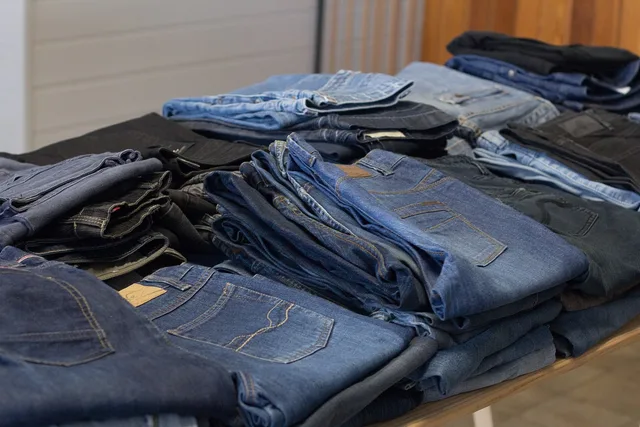
Textile reuse and recycling cover several different activities. A jacket resold intact, a shirt cut into wiping cloth, and cotton fabric opened into fiber all leave the first owner's closet, but they do not preserve the same amount of product value.
The right route starts with the item's present condition and a confirmed downstream use. It does not start with the label on a collection box. Prevention, the step before any route, is where the guide to sustainable fashion basics begins. That guide covers buying less, care, repair, and choosing materials that last.
What reuse means
Reuse keeps a product or component in service without breaking it back into raw material. Common routes include direct handoff, resale, rental, uniform redistribution, repair followed by resale, and creative alteration.
Good reuse candidates are clean, safe, functional, and suited to an actual market. A formal coat with a missing button may need a small repair. A burned children's garment, moldy blanket, or recalled protective item should not be passed to another person simply to avoid disposal.
The US textile system remains largely linear, and a NIST workshop report on textile circularity identifies needs that include harmonized sorting standards, better labeling, shared data, improved collection, and stronger end markets. That system view matters because a household can sort carefully while a collector still lacks a buyer, recycler, or reliable reporting process.
What recycling means
Recycling transforms discarded textile material into feedstock for another manufacturing process. The output may become fiber, yarn, nonwoven padding, insulation, absorbent material, composite filler, or a chemical building block.
Two broad methods are useful to distinguish:
Basic action
- Mechanical
- Shreds, cards, and re-spins textile waste into fiber, yarn, or nonwoven.
- Chemical
- Dissolves or depolymerizes textile material into polymers, monomers, or chemical building blocks.
Typical constraint
- Mechanical
- Shortens fiber length, so output is often lower grade; sensitive to contamination and mixed fibers.
- Chemical
- Needs clean, sorted feedstock and specific chemistry; cost, yield, and capacity vary.
Mechanical vs Chemical Recycling
Mechanical
- Basic action
- Cuts, shreds, tears, opens
- Typical constraint
- Fiber length and strength fall
- Output examples
- Fiber, yarn, nonwoven padding
Chemical or dissolution
- Basic action
- Separates or converts polymer
- Typical constraint
- Purity, chemicals, energy, recovery
- Output examples
- Chemical building block
These labels do not determine environmental performance by themselves. A process must be evaluated with its feedstock, yield, energy, chemistry, emissions, waste, output quality, transport, and displaced material.
A practical order for decisions
Use this sequence, while allowing safety and local rules to override it:
Practical Decision Order
- Keep using the item
- Clean, maintain, or repair
- Alter or use a sound component
- Transfer for verified reuse
- Send to confirmed recycling
- Use required residual-waste route
- Preventkeep using what you own, and repair or alter it.
- Reuse directlygive the item to a known next user.
- Resell or rentuse a shop or platform with a confirmed buyer.
- Redistributeuse a workplace or uniform take-back scheme.
- Recyclesend to a route that matches fiber, construction, and contamination.
- Disposeuse trash or hazardous waste as local rules require.
This is a decision order, not a promise that every item can move through every step. Underwear, contaminated workwear, coated fabrics, mixed shoes, and products with electronic parts may face different hygiene, safety, or processing rules. Steps one and two lean on the durability and care handbook, which shows how far maintenance can stretch a garment's life.
Items that are neither reusable nor recyclable should go to the right disposal route. Put ordinary worn-out textiles in the trash if your local rules allow it. Take items with mold, pests, or chemical contamination to a household hazardous waste collection. Do not put hazardous textiles in a donation or recycling bin.
Recalled protective equipment should follow the recall notice.
Sort by condition before fiber
Sort by Condition Grade
- Ready for use after cleaning
- Repairable at reasonable effort
- Not wearable but suitable for material route
- Unsafe, contaminated, or no accepted route
Then record category, size, season, fiber label, stretch content, lining, coating, trims, damage, moisture, odor, and suspected contamination. A fiber label can help, but an old, missing, or inaccurate label should not be treated as laboratory proof.
Why construction changes the answer
A plain, undyed, single-fiber fabric may be easier to process than a laminated jacket with membrane, adhesive, zipper, elastic, printed transfer, and mixed-fiber lining. Even a simple blend can complicate separation. Finishes may interfere with a process or affect the recovered output.
Designers can improve future options by using durable construction, replaceable parts, accessible seams, material disclosure, and fewer combinations that cannot be separated. Those choices still need to match actual repair and recycling infrastructure. That design side is covered in the guide to circular fashion design.
Collection is not an outcome
A collection program should state who operates it, what it accepts, whether wet or damaged items are excluded, how reusable goods are graded, which recyclers receive non-reusable fractions, and what happens to residues. It should also explain whether material is sold or exported.
Track mass at these points:
| Stage | Useful record |
|---|---|
| Intake | Total weight and item count received, by date and source. |
| Sorting | Weight by grade: reusable, recyclable, residue; moisture and contamination noted. |
| Reuse | Weight and item count sold, donated, or exported for reuse; destination. |
| Recycling | Weight sent to each recycler, with material type and processor name. |
| Residue | Weight landfilled or incinerated; reason for rejection. |
Track Mass at These Points
- Receivedweight by date, site, source
- Reusedweight or item count sold
- Recycledweight accepted by named processor
- Storedclosing inventory and age
- Residualweight and final treatment
Do not subtract collected weight from waste and call the difference recycling. Sorting losses, moisture, packaging, rejected items, and unsold inventory can change the result. Verifying such flows is a supply chain traceability problem: the same event, quantity, and evidence records apply.
To find a collector, check your city or county public works website, your state environmental agency, and the operator's own permit or registration. In Canada, check the provincial recycling authority.
Ask who owns the material after collection, where it goes, whether damaged items are accepted, and for last year's mass by destination. National charity chains such as Goodwill and The Salvation Army run drop-off sites, and some municipalities contract with collectors such as Helpsy.
Photo and credit
The photo shows recovered textile fiber intended for insulation and absorbent products. It is an example of a material route, not evidence that all collected clothing becomes fiber or that this output can become new clothing.
How to assess a reuse claim
A transfer to a wholesaler may be an intermediate transaction rather than a final reuse outcome.
Item counts and weight answer different questions. A program that handles many lightweight shirts can look large by item count but modest by mass. Report the unit and avoid converting between them without documented average weights.
How to assess a recycling claim
Identify the input, process, processor, accepted date, verified mass, yield, output, destination, and rejected fraction. Distinguish textile-to-textile output from products such as insulation or wiping cloth. Neither route should be hidden behind the single word "recycled."
A product-content claim needs separate evidence linking eligible recovered input to the finished product. The FTC's guidance on recycled content claims permits them only for materials recovered or diverted from the waste stream, with substantiation behind any pre-consumer or post-consumer distinction. A collector's recycling rate does not prove the recycled percentage in a new sweater.
What individuals can do
- Buy less when an existing item works.
- Follow care instructions and repair early damage.
- Offer wearable items directly or through a program with clear acceptance rules.
- Keep donations clean and dry.
- Do not conceal contamination or put trash in a textile bin.
- Check local instructions because accepted items and routes vary.
Common questions
Is donation always reuse?
No. Donation is a transfer into a sorting system. Reuse occurs only if the product returns to use.
Is downcycling still recycling?
It can be, if discarded material becomes manufacturing feedstock for another product. Name the output so readers can judge the retained value.
Should damaged clothing go in a donation bin?
Only when the operator explicitly accepts it for a confirmed material route. Follow the posted condition and packaging rules.
Can blended fabric be recycled?
Sometimes. The answer depends on the blend, construction, contamination, process, capacity, and local market.
Does recycled fiber make a garment circular?
Not by itself. Durability, safe chemistry, manufacturing impacts, future recovery, and actual use still matter.
In this guide
- How to choose a responsible route for used textiles, from the ground upUsed textile routing guide: inspect condition, protect health and safety, check local acceptance rules, verify the operator, document handoff, and review outcomes.
- A framework for textile reuse and recycling comparisonThis textile reuse and recycling comparison framework uses seven criteria to assess direct reuse, repair, remanufacture, recycling, and residual treatment.