Features
Part of 9 things about garment durability and care worth your time
Garment durability and care example: qualitative cardigan
A garment durability and care example tracks a fictional cotton-wool cardigan through complaints, named tests, care labeling, and qualitative decisions.
What to take away
- This fictional case separates observed facts, working hypotheses, test results, and decisions.
- One garment can fail through several mechanisms at different rates.
- A care-label change cannot replace a needed material or construction correction.
- Repeated care should measure dimensions, appearance, seams, surface, and function separately.
- Release needs production-equivalent confirmation and a plan to monitor real ownership.
This garment durability and care example shows how a product team could investigate a dark cotton-wool cardigan. The company, garment, numbers, and results are fictional. The method is educational and does not establish a universal specification. Its vocabulary comes from the durability and care fundamentals.
The product and the complaint pattern
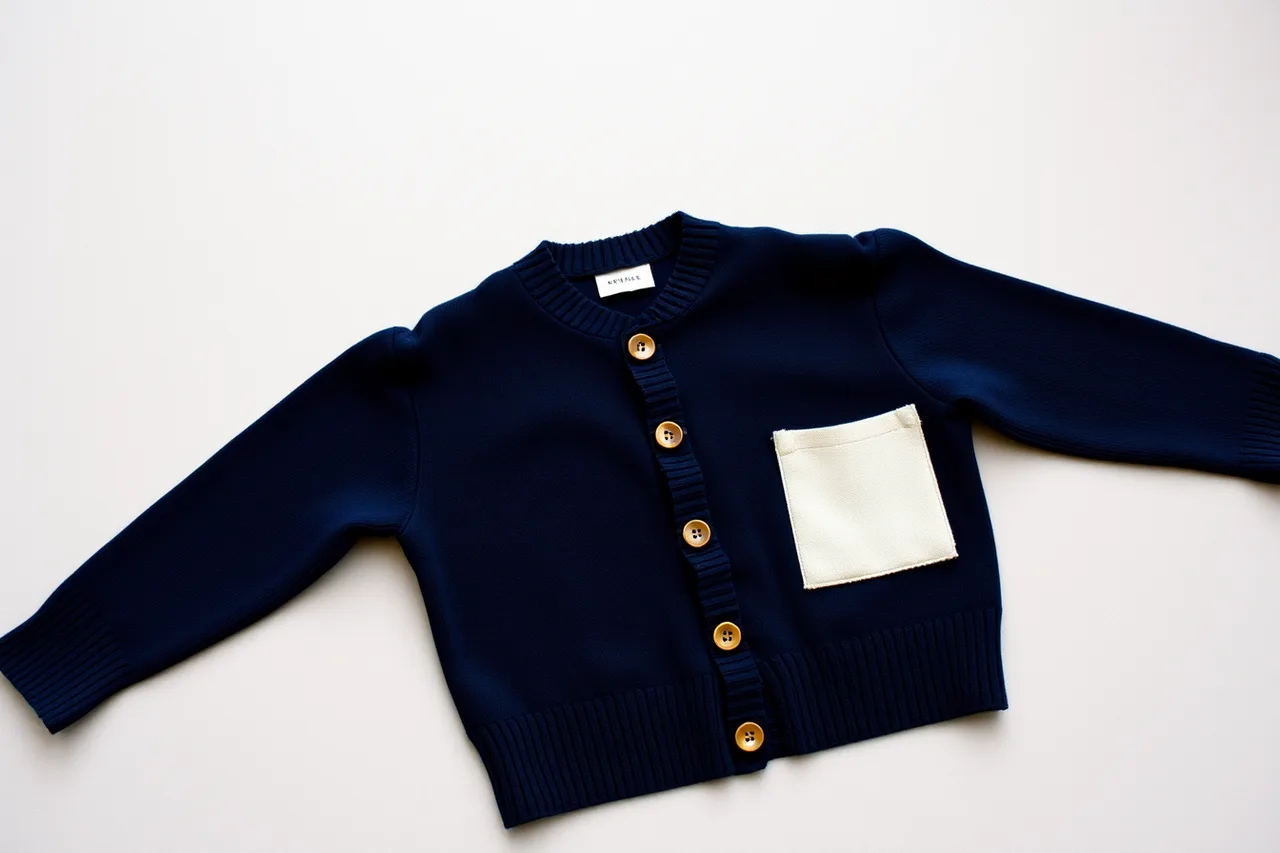
The cardigan has a dark navy jersey body, ribbed cuffs and hem, a light woven pocket lining, fusible reinforcement behind the button band, and imitation-horn buttons. It is sold for frequent office wear with this instruction:
The body uses cotton and wool, both bio-based natural fibers, but the case gives no fiber-content percentages, sourcing evidence, or certification claim. A durability result does not by itself substantiate a broader sustainability claim; it informs whether this construction withstands the stated use and care.
Machine wash cold, gentle cycle. Reshape and lay flat to dry. Cool iron if needed.
Within eight weeks, customer service records three complaint types:
- body length decreases while sleeves appear nearly unchanged
- pocket edges show light-blue staining
- pills form under the arm and near shoulder-bag contact
Twenty-eight complaints among 4,600 units do not prove the cause or total rate. They do justify a structured review because the symptoms affect fit and appearance and may share a care-related origin.
Question and scope
The team writes one main question:
Does the production cardigan remain within approved dimensional, staining, surface, and construction limits through its expected wash and wear pattern?
The scope includes two production lots, three sizes, both navy dye lots, and two factories. The team excludes unrelated colors until records show whether they share materials and processes.
The European Commission's EU Strategy for Sustainable and Circular Textiles provides policy context. A Joint Research Centre (JRC) preparatory study for EU textile policy notes that garment aging involves several measurable parameters and discusses the difficulty of using one standardized method to simulate overall aging. That is useful framing, not a pass limit for this cardigan. The team therefore measures each predicted failure and adds controlled wear evidence rather than seeking one lifetime score.
Evidence log
| Evidence | What it can show | What it cannot show |
|---|---|---|
| Complaint photos | Symptom, location, reported timing | Exact care conditions or prevalence |
| Returned garments | Construction and damage after ownership | Original dimensions without records |
| Retained production samples | Lot-specific new condition | Customer wear conditions |
| Fabric test reports | Selected material properties | Complete-garment behavior |
| Factory records | Cutting, sewing, fusing, and lot history | Unrecorded process variation |
| Controlled care trial | Change under stated conditions | Every household variation |
| Wear trial | Combined fit, friction, and care | A universal lifetime result |
The team photographs and quarantines returns. It records label wording, purchase date, owner-reported care, size, lot, and damage location. Reports with missing history remain in the dataset but are marked incomplete.
Initial inspection
Returned cardigans reveal three clues:
- Body shortening is greatest in length, while sleeve change is lower.
- Blue staining sits where wet navy body fabric contacts the light pocket lining.
- Pilling is concentrated in friction zones, with less change on the center back.
The fusing is intact and buttons remain secure. These observations narrow the work but do not yet prove mechanisms. Matching symptoms to mechanisms is the job of the durability failure guide.
Retained samples show that body panels from one lot have less finishing stability in the length direction. Factory records also show the pocket lining supplier changed before the second lot, but no complete-garment staining check was added.
Test plan and limits
Before running the trial, the team approves limits for:
- body and sleeve dimensional change at 1, 5, 10, and 20 care cycles
- side-seam twist and rib recovery
- staining of the pocket lining
- pilling grades at underarm, shoulder, and low-friction zones
- seam appearance, fusing, button attachment, and fit
These methods assess specific properties; they do not set this cardigan's acceptance thresholds. The case reports results qualitatively and does not publish numeric limits, so its pass/fail decisions cannot be reproduced as a product specification.
It tests the labeled process and a foreseeable higher-stress household variation. The latter is diagnostic and helps decide whether a warning is needed; it is not silently substituted for the labeled method.
Wear participants receive the same bag type and a defined wear schedule. They record hours, layering, weather, laundering, and unusual events. Inspectors do not know which lot each garment comes from during visual ratings.
Results
| Finding | Lot A | Lot B | Decision |
|---|---|---|---|
| Body length after 10 labeled cycles | Within limit | Outside limit | Fail Lot B |
| Sleeve length | Within limit | Within limit | Pass |
| Pocket-lining staining | Minor | Outside limit | Fail Lot B system |
| Friction-zone pilling | Near limit | Near limit | Review both |
| Low-friction pilling | Within limit | Within limit | Pass |
| Fusing and buttons | Within limit | Within limit | Pass |
The directional shrinkage and lot difference support a fabric-stability problem rather than a universal cardigan pattern problem. The pocket result points to an interaction between navy fabric and changed light lining. The location-specific pills show that friction and surface propensity both matter.
No one result explains all three complaints.
Corrections
The team takes separate actions:
- tightens length-direction stability requirements for the body fabric
- restores a compatible pocket lining and adds a complete-garment staining check
- adjusts yarn and surface-finishing specifications, then repeats friction-zone evaluation
- keeps flat drying because hanging trials distort the wet cardigan
- rewrites reshaping instructions with concrete measurement points for customer care guidance
It does not add "wash separately forever" to excuse staining during normal wear. It also does not switch to dry-clean-only language without evidence, because that would impose cost and leave the material problems unresolved.
Care, durability, and household energy
Care guidance can weigh resource use once garment safety and tolerance are set. The US Department of Energy's Energy Savers guide says less or cooler water can cut washing energy. It advises avoiding overdrying, using moisture sensing when available, and air drying suitable items.
The cardigan already needs flat drying for shape, so the team does not turn this general advice into a tumble-drying claim.
The example shows the boundary between general guidance and product evidence. A lower-temperature wash can reduce energy and some thermal stress, but it still must remove expected soil and preserve the actual garment. Flat drying may avoid tumble action, yet it needs space, airflow, and correct support.
Confirmation run
Corrected cardigans are produced with bulk-equivalent fabric, lining, thread, fusing, buttons, sewing, and finishing at both factories. Samples repeat the full relevant matrix rather than only the failed measurements. This catches possible side effects, including seam response after the new fabric finish. The pre-release durability checklist gates exactly this confirmation step.
All pre-set limits pass. Variation is wider in the largest size but remains inside the approved range. The team documents that margin and increases early production sampling instead of declaring the issue impossible to recur.
For U.S. sales, the Federal Trade Commission's Care Labeling Rule (16 CFR Part 423) requires care instructions supported by a reasonable basis. The care label remains machine wash cold, gentle cycle, reshape, and dry flat. Supporting records identify the exact product revision and exclude earlier lots.
Post-release monitoring
For twelve weeks, customer service codes reports separately for length change, width change, twist, lining stain, pilling location, seam failure, and care history. A trigger is set for review by lot and factory rather than only total complaints.
Repair staff record whether a reported problem can be restored, how long it takes, and whether function and appearance return. Pilling removal alone is logged as maintenance, not proof that the surface specification succeeded. The city jacket circularity example builds the same monitoring into a take-back service.
What this example does not prove
The case does not establish that cotton-wool cardigans should use one test package, cycle count, limit, or care route. It does not predict every user, climate, machine, detergent, or storage condition. It also establishes no end-of-life route: without fiber percentages and evidence of an available collection or recovery pathway, the case cannot substantiate a recyclability claim for the cardigan's body, lining, or trims. It shows a decision pattern: define the question, preserve evidence, separate mechanisms, set limits early, correct causes, confirm production, and monitor use.
Common questions
Why not change the label as soon as complaints appear?
A stricter label might burden owners without correcting unstable fabric, staining, or surface design. Investigate the mechanism first.
Why test more than the failed property?
A material or process correction can affect seams, color, feel, shape, and other functions. Confirm the complete garment again.
Are 28 complaints enough to declare a defect?
The count alone is insufficient. Severity, reporting bias, lot pattern, sales timing, care history, and controlled evidence all matter.
Why include a higher-stress care condition?
It can expose foreseeable risk and help decide whether a warning or design margin is needed. It should be labeled as diagnostic and kept separate from proof of the stated process.
What makes the example evidence-led?
It distinguishes observations from hypotheses, identifies limits before testing, records source boundaries, corrects separate causes, and verifies a production-equivalent result.