Guides
Bio-Based Insulation in Winter Jackets: A Canadian Reality Check
Bio-based insulation winter jackets work in parts of Canada if fill power, moisture regain and weight match the cold. Prairie winters need more than plant fill.
What to take away
- Bio-based insulation in winter jackets is not one climate solution. It works better in damp Vancouver cold than in dry Winnipeg cold.
- A jacket with less than 200 g/m² of plant-based fill is not a standalone parka for a prairie winter below -15°C.
- The realistic Canadian role is a shoulder-season puffer, a midlayer, or a wet-coast jacket.
- Check the fibre content under the Textile Labelling Act and ask for the fill's moisture regain before you buy.
What the constraint removes
The measurable constraint is one person, one jacket, no lab access, and a hard climate envelope. The shell and fill together must hold a resting adult warm at -20°C dry prairie cold while staying breathable enough for a 10-minute walk at -5°C. I set two cutoffs: a standing warmth of at least 2.0 clo and a moisture vapour transmission rate above 5,000 g/m²/24h. Thermal insulation is measured in clo, where 1 clo keeps a resting adult comfortable at about 21°C.
This rules out standalone kapok, milkweed and hemp fleece fills below -10°C. Those plant fibres have good moisture regain, but their loft collapses under body weight after a few seasons.
Under the Textile Labelling Act, a jacket sold in Canada must identify its fibre content, but that label rarely gives fill power or clo. You can use the Canadian Textile Labelling rules to check what is actually in the fill, not what the hangtag implies.
What still works
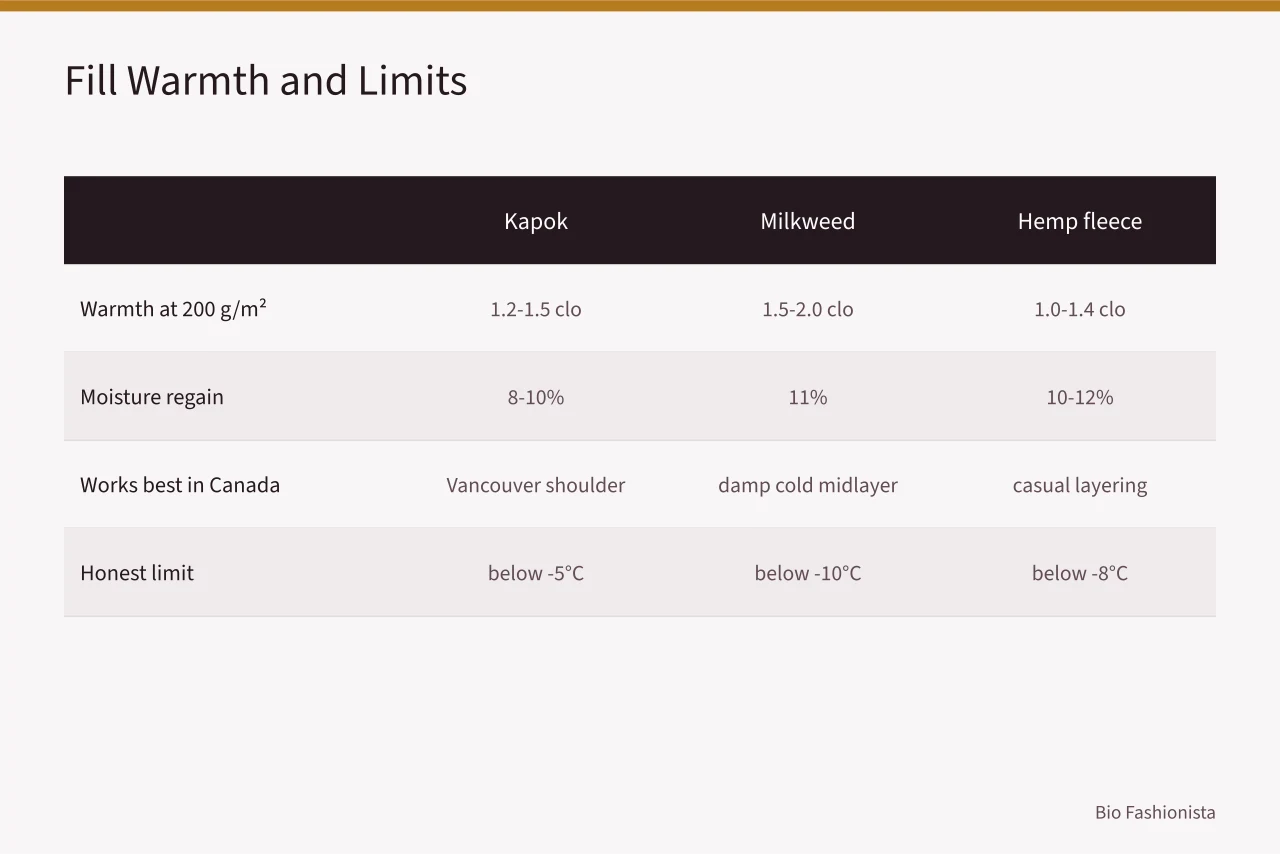
| Insulation fill | Warmth at 200 g/m² | Moisture regain | Works best in Canada | Honest limit |
|---|---|---|---|---|
| Kapok | 1.2-1.5 clo | 8-10% | Vancouver shoulder seasons | below -5°C |
| Milkweed | 1.5-2.0 clo | 11% | damp cold, midlayer | below -10°C |
| Hemp fleece | 1.0-1.4 clo | 10-12% | casual coats, layering | below -8°C |
| Recycled polyester | 1.8-2.4 clo | 0.4% | dry cold, active use | very damp if uncoated |
These ranges are illustrative, not lab results. The table shows why plant fills fail first in dry cold.
Wool and recycled polyester still work across more Canadian conditions. A 200 g/m² recycled polyester puffer holds loft better than plant fills and dries quickly. Wool insulation, used by brands such as Icebreaker and Smartwool, manages damp cold without a plastic shell.
Moisture management in textiles matters more than fill type in coastal British Columbia. A plant-based puffer can pass if the shell moves sweat before it condenses inside. This is where comparing the main routes helps before you choose a fill.
Compromises worth making
- Accept a bio-based puffer as a midlayer under a windproof shell in prairie cold.
- Choose a blend of recycled polyester and plant fibres to keep loft while cutting plastic.
- Buy a shorter jacket for Vancouver rain and use a merino base layer for warmth.
At end of life, a bio-based fill inside a polyester shell still enters the same waste stream. The Government of Canada's plastic waste and recycling page explains why textile-to-textile recycling remains limited.
Before you accept a recycled polyester shell, check do bio-based synthetics shed microplastics. Some bio-based synthetics still shed in the wash.
Compromises that are not
Do not accept a kapok-filled jacket for a Saskatoon winter on the claim that plant fibre is warm. Kapok loft drops under body weight, and the fill shifts after one season.
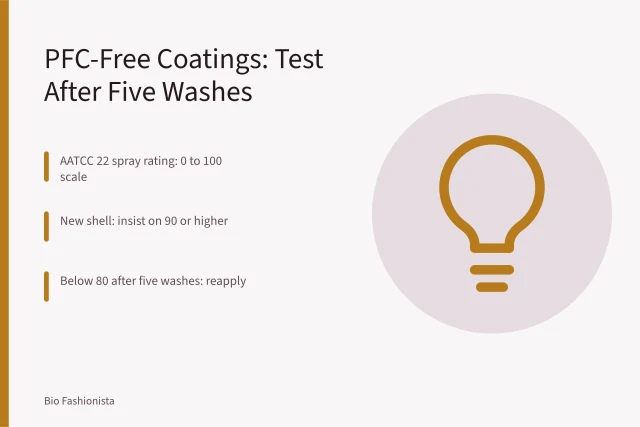
Do not accept a bio-based puffer as a rain shell in Vancouver unless the outer fabric has a durable water repellent finish that is PFC-free. PFAS concerns are real, but a non-fluorinated finish needs reapplication often.
Labels that say bio-based without stating the percentage fall under greenwashing in Canadian fashion brands. The Textile Labelling Act sets the floor, not the marketing.
When to stop and resource it properly
Layering a bio-based puffer over a wool sweater stops paying when combined insulation weight reaches 250 g/m². At that point, the jacket is no lighter than a 700-fill down parka, and moisture release drops enough to cause clamminess on a walk. Stop the workaround there. Resource a down or high-loft synthetic parka for temperatures below -15°C, and keep the bio-based puffer for the coast.
Example: two Canadian winters, one jacket
Example: a commuter in Halifax faces -8°C wet cold and rain. A 120 g/m² milkweed blend puffer under a waterproof shell works. The same jacket fails in Regina at -25°C dry cold, even over a sweater. For Regina, a 250 g/m² recycled polyester or down parka is the honest choice.
Common questions
Does bio-based insulation keep you as warm as down? No. Plant fills have lower loft and higher moisture regain, so they lose warmth when wet. Down still wins for dry cold.
Can I wear a bio-based puffer in a Canadian prairie winter? Only as a midlayer under a windproof shell. Below -15°C, you need at least 250 g/m² of high-loft insulation.
Is bio-based insulation better for the environment? It depends on the shell and coatings. A plant fill inside a polyester shell still sheds microplastics and enters the same waste stream.
What should I check before buying? Check the Textile Labelling Act fibre content, the fill weight, and whether the shell has a PFC-free durable water repellent finish.